|
|
|
|
 |
|
 |
||
 |
||
 |
||
 |
 |
|
|
 |
||
 |
||
 |
| Little kown fact:
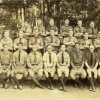
When looking at the 1963 staff photo I remembered that it was the year when we tore down Yale latrine! I'm sure that Dirk Van Hook was part of the crew smashing it to pieces with sledgehammers and axes. I drove the truck hauling away the fragments. ~ Frank Maguire |
 |
Keith Nixon from the UK was our International Camp Staff member in 1986. Click on his photo to read his story about his trip to Camp Hinds. |
|
 |
|
 |
||
 |
||
 |
||
 |
 |
|
 |
|||
 |
|
||
 |
|||
 |
|||
 |
|||
|
 |
|
 |
||
 |
||
 |
||
 |
||
 |
 |
|
|
 |
||
 |
| Greetings from Vermont
In 1978 I was the Program Director. I was a high school music teacher then, teaching in Plattsburgh, NY (across Lake Champlain from my family in the Burlington, VT area) and was speaking to my Uncle Ralph during the winter of 77-78 that I did not want to work locally that coming summer. Ralph was a scout executive (he worked his way up through councils from Nashua, NH through MA, Nebraska, Colorado and eventually becoming the scout exec in LA) and knew Bud Jeffries who called me and offered me the one year position at Hinds in preparation for being the Base Director for the Matagamon HIgh Adventure Base the following summer (which I did in 1979). I had a great summer at Hinds (and the following year at Matagamon), ones I remember fondly and often speak of with people here. Being from Vermont, I stayed over on Saturday nights (even had a summer girlfriend with a young lady from North Windham) and enjoyed camp life, planning each week's events, going to National Camp School (where I was offered a teaching position following my week there), working with Mike, Steven, George, Ken and the others there. I even got involved in the music program at the Amherst Camp around the corner and played there once a week in one of their jazz ensembles. Now I am too busy supporting my family (with multiple part-time jobs and three home businesses) to do much in Scouting besides serve as a merit badge counselor. My two boys are scouts (my wife was their den mother) with one working on his Eagle Project and the other a Star headed in that direction. Too many Camp Hinds memories to bore you with, but again, appreciate your work on the site and please give anyone who might remember me my email address. Take care
|
|
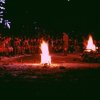
To Maine with the Boy Scouts and Percy Dunn April 6, 2009 A surprise letter came from Scout Executive Percy Dunn in the spring of 1943. He had become the Executive of Pine Tree Council in Maine and needed a Field Scout Executive to be Chief of Staff at Camp William Hinds beginning in June. Would I consider joining him again in this new assignment? The offer was attractive since I was looking for a new and greater challenge in this time of national crises. It was not my intention to leave the Christian ministry. A war time commitment interested me. At Percy Dunn’s prompting, I flew to Portland, Maine for a job interview. It was always inspiring to be with P.L. Dunn and this visit convinced me to team up with him again in Pine Tree Council and Camp William Hinds. Percy introduced me to Maine lobster at Boone’s Place on the wharf in Portland. How delicious! There were many decisions to make and arrangements to settle before leaving for the Scout camp in early June. Madeline was expecting our third child the first of June so the church agreed for her to stay in the parsonage until I would come for her and the children in August. Clora Harris volunteered to take Madeline to the hospital when the time came. John Preston—named for his two grandfathers–was not born until June 30, 1943, a month later than expected. Through all the stress of this transition period Madeline demonstrated remarkable courage. Looking back, I marvel at her faith and stamina. The ensuing weeks were perhaps the most trying of our lives. Camp William Hinds, owned and operated by Pine Tree Council Boy Scout of America, was located on Panther Pond with the Tenney river running through the camp and emptying into the lake. Pond was a misnomer. It was a four mile long lake, half a mile wide. The water was clear and refreshingly cool. Most of the camp property was wooded. I was enthralled on my first visit to the camp. As camp Chief of Staff, I worked with thirty-five adult and junior staff men and two-hundred-fifty Scouts for two-week periods through the summer. Soon after camp began problems with some veteran staff members developed. I do not want to give the impression that the 1943 camping season at Camp William Hinds was a failure. Five or six adult staff members, and perhaps as many junior staff personnel, created the problems. There were a number of talented and dedicated men who were loyal to me and who helped to make the camping experience memorable for the hundreds of Boy Scouts in camp. However, had it not been for the unwavering support of Percy Dunn, I doubt if I would have survived the summer. Immediately after camp was over I drove the camp truck to Alfred Station to bring our family and household goods back to Auburn, Maine. Because it was war time, special arrangements to purchase gasoline for the truck and our V8 Ford had to be made with the proper authorities. Returning to Madeline and the children after the trauma of the summer was an emotionally happy experience. What a thrill to see baby John, now eight or nine weeks old, for the first time. He was a beautiful baby! I could only guess at how difficult the summer had been for Madeline. She was a “survivor”. Tears were shed as we drove away from Alfred Station in the loaded truck and our Ford car. Madeline had Anne, Daniel and John with her as she drove. The more than four years with Second Alfred church, our first pastorate, had been fruitful and happy. We were leaving our first home, after the Gothic in Alfred, and many friends dear to us were being left behind. The trip to Maine was arduous, especially for Madeline. We were fortunate to be able to spend the first night on the road in Berlin, New York with our friends, Pastor Paul and Ruby Maxson. It was difficult to find a motel the second night. No lights were allowed outside places of business because of the war so we literally groped our way into a motel kind enough to take us in. It was heartwarming and reassuring to have Percy and Clara Dunn help us settle in to our rented apartment on Beacon Avenue in Auburn, Maine. Lewiston Auburn is the twin city that was headquarters for the Pine Tree Council district I was to serve as Field Scout Executive. Our first floor apartment was on top of a hill that overlooked the city of Lewiston and the Androscoggin river. Remodeled from an elegant home, the apartment had hardwood floors and a beautiful fireplace with a ceramic arch decorated with a woman’s face, oak leaves and acorns. It was pleasant to come home from night Scout meetings and sit with Madeline in front of a cheery fire. I often brought home a huge Italian sandwich or a lobster sandwich to enjoy together. We paid $30.00 a month for the apartment. A coal furnace was our heat source and, because of war time restrictions, we brought coal home, one bag at a time, in our car. I foolishly used kerosene one morning to relight the furnace fire. The kerosene exploded in my face, singing my hair and burning off my mustache. It could have been a major tragedy but it was an embarrassment for a Scout Executive. Because washing machines were not available during the war, Madeline was forced to wash all our clothes by hand until the Irish lady next door saw her predicament and gave her a working old electric washing machine. We were thankful for it and did not replace it until after the war. The washing was done by putting the clothes in a revolving basket with wooden slates. The war caused restrictions and inconveniences that are now forgotten. Being Field Scout Executive for the Lewiston-Auburn District of Pine Tree Council was interesting and demanding. The district covered the communities from Lewiston-Auburn north to Rumford. More than four feet of snow the winter of 1943-44 made travel sometimes hazardous. Days found me in the district office much of the time and most week nights I was visiting Troops or conducting committee meetings relating to Scouting. A number of Troops were made up of French-Canadian Scouters and Scouts whose meetings were conducted using the French language. I remember Freddie LeBranche who was the Scoutmaster of an excellent Troop. He and his wife became close friends. The British had a base at the Lewiston airport for training British pilots to fly Grumman aircraft. A number of the pilots were English Boy Scouts and came to our office to get acquainted. We had Norman Bleers, a charming British Scout, for dinner several times. We wonder, “Did he survive the war?”. Those were the terrible days when England was being subjected to devastating bombings day and night. “The Happy Gang”, a Canadian radio program we heard almost every day, often sang, “There’ll always be an England, and England will be free, As long as there’s a cottage small beside the crystal sea”. When there was a movement under way to send English children to the United States to escape the bombings, Madeline and I applied to host one. We corresponded with the father of the child scheduled to come to us and he sent us a burned out German fire bomb. It was decided not to evacuate the children. Madeline and I participated in a number of church and community activities in Lewiston-Auburn. Madeline sang in the Congregational church choir and was active in a Baptist Women’s organization. I preached many Sundays in rural and small town Baptist churches. My “barrel” of sermons was made use of often. An experience with birds deserves telling. I came home from the office for lunch one day to find a flock of beautiful birds eating the seeds on the ash tree in our front yard. The markings on the birds were yellow and black and a search of our bird guide led us to believe they must be Evening Grosbeaks. One hitch was that the guide said this species was seldom seen east of the Mississippi river. This flock of birds couldn’t have been farther east than this. When I telephoned Dr. Sawyer, a Bates College biology professor and a member of my District Board, he assured me that we were seeing Evening Grosbeaks. They had been observed in Maine for several years. It was intellectually stimulating to meet monthly through the winter with Peter Bertocci, a Bates College professor, and the local Unitarian minister. We met in our home and took turns presenting a paper on some issue and then discussing it. I believe sociology was Dr. Bertocci’s field. He later became a professor at Boston University and authored one or more books. I can’t recall how the idea of our getting together originated. We enjoyed it. I joined a group of people interested in target archery in forming the Orumby Archery Club. “Orumby” was the name of a renowned Indian in the history of the area. We established an archery range on which we could shoot the York round requiring a number of 100 yard shots. In the archery club I met Harold A. Titcomb (Uncle “Hat”). His name was prominent in target archery circles and he was most helpful to us in organizing our local club. Madeline and I were honored to have him as a guest in our home and I was in touch with him later. Our family life in Maine sometimes was lonely, especially for Madeline. We missed our families and friends acutely and were thrilled to have cousin Vida Randolph Barrs bring her three children from Boston to visit us. Christmas Eve we attended the very large and beautiful Saint Peter’s Catholic church Midnight Mass. The priest was active in our Scouting program. Anne was five years old in June of 1943 and so went to kindergarten in Auburn in September. It was exciting to follow her progress and enthusiasm in school. One winter day Daniel, who was not yet three years old, wandered away from our house causing Madeline to call me at the office greatly alarmed. I rushed home to receive a call from the nearby fire station that a little boy was there who might be ours. Baby John made us all happy as he grew. He was caught one day with a caterpillar in his mouth as he sat on the front lawn. Before camp began in 1944 we were surprised to receive word from Rabbi Karl and Eva Weiner that Karl was going to be on the staff of a private camp not far from Camp William Hinds. Arrangements were soon made between us to have Eva and their baby, Danny live with Madeline and our children for the camp season. It worked out well for Karl and me to have the same day off each week from our camps and be at home together with our families. Madeline and Eva enjoyed being together. They had religious discussions in which they compared Old and New Testament scriptures. Eva was pleased to learn how to sew from Madeline. After the camping season the Weiners moved to Colorado Springs, CO. Serving as Chief of Staff for Boy Scout Camp William Hinds on Panther Pond was sheer joy in 1944. Percy Dunn and I recruited the entire staff and we were in full control of the management and program for the camp. I was happily surprised to be inducted into The Order of the Arrow, a national Scout organization, in an impressive Indian ceremony. I supervised the construction of an outdoor chapel and an archery range for the camp. Blueberries grew in abundance on the camp property and one week we sent the campers out, by tents, with #10 cans to pick blueberries. The winning tent got a watermelon as a prize. Our cook baked blueberry pies and blueberry muffins enjoyed by everyone. One unique program event during the camping season stands out in my memory. The father of a camper was a talented camper, fly fisherman, canoeist and general outdoorsman. On our invitation he took a day at camp to set up a model camp and demonstrate axmanship, fly casting and poling a canoe. His relating of fishing and camping experiences kept the Scouts spellbound at evening campfire. An Indian council fire I led at Camp William Hinds one evening when the “Old Timers” from Portland, Maine were our guests is unforgettable. The “Old Timers” were affluent business men who were supporters of the camp and who came to visit every year. The fire was laid in the campfire ring and the Scouts filed silently into the arena with blankets over their shoulders and wearing single feathers on their heads. I wore a full Indian headdress and opened the ceremony by invoking blessings from each point of the compass. Facing north with arms outstretched I intoned, “O north wind, bring us FIREI”. At that moment flames burst out of the wood laid for the fire. It was awesome! As you may have guessed, the burst of fire was brought on by a mixture of chemicals that were activated by a staff man in the edge of the circle who pulled on a black thread attached to the neck of an open bottle at the base of the firewood. I had never seen it done before but it worked perfectly. ~Written by Elmo Fitz-Randolph in his autobiography. |
| Back to Hinds
My heart yearns for a certain place
In this real world that finds no peace
~ Owen Maguire 2015
|
The Canvas Falls
The canvas falls
Many thanks are to be given and shared
An original poem, dedicated to all the members of the 2015 Camp Wm Hinds Staff as they close the season. Congrats on a job well done! All the best
|
|
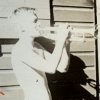
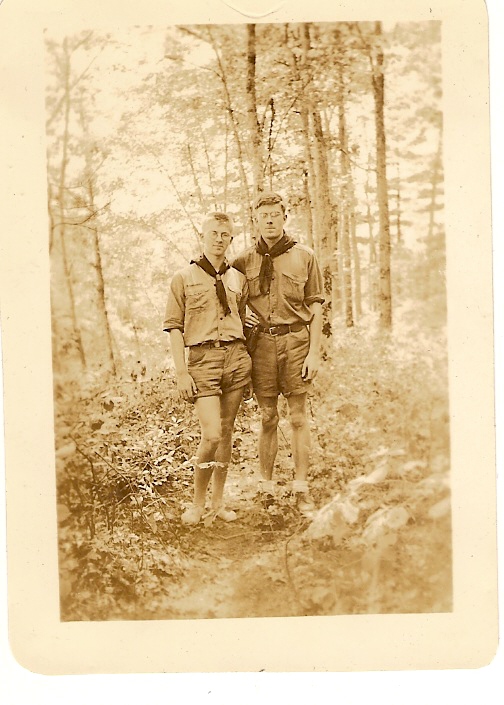
Thank you for doing this. That was quite a trip down memory lane! I have enclosed a photo which I believe is my father, Casper Cowen, and his brother Fredrick Cowan. The photo near the end on the Merrill Luthe scrap book labeled “Cowan” is Fredrick Cowan, probably about age 14. He was two years younger than my father. I got as far as Life scout. I don’t think I got another merit badge after I got into High School. I guess I didn’t want Eagle badly enough. I was in the Order of the Arrow. You know where the induction ceremony takes place. After the ceremony, two others and I stayed behind to put out the candles and the camp fire. The fire was almost out when we realized how dark it was and that we had no flashlights. We huffed and puffed on some embers to get a flame so that we could light a candle to light our way back to the road. One other memory from Camp Hinds. Alan Graffam (the Deering band leader’s son) always brought his trumpet with him. So every once in a while we would hear the Deering fight song from one end of the camp to the other. One thing that you might want to add to the biography of my father is that, after he retired, he wrote THE book on Maine real estate law. It is entitled Maine Real Estate Law and Practice. There was no book on Maine real estate law before that. It was published in 1989. It has to be kept up to date, so it is currently being kept up to date by J. Gordon Scannell, Jr. ~ Seth Cowan Feb 2020 |
|
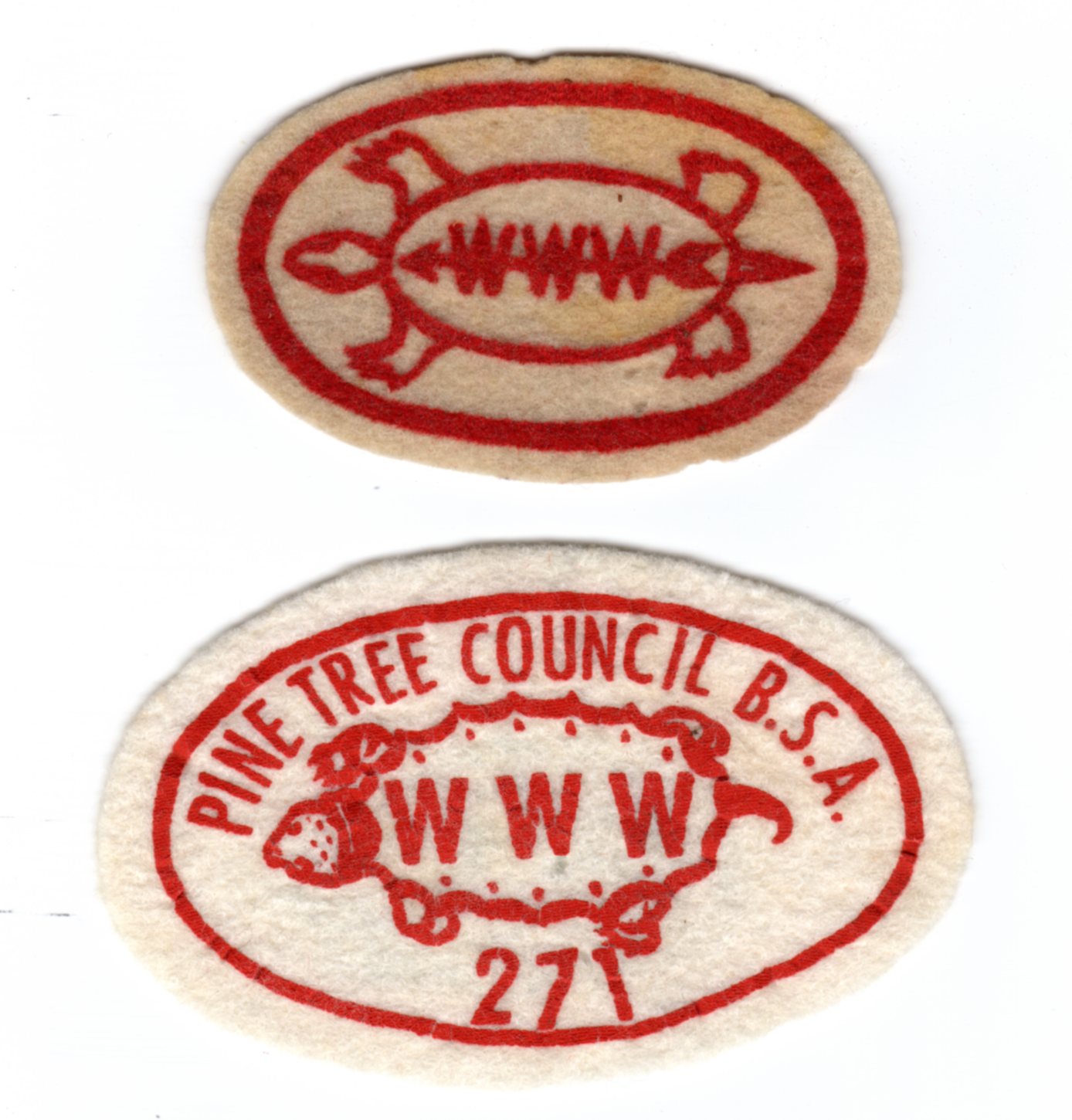 |
I’m attaching a photo of two rare OA Madockawanda Lodge patches that
I have from the 50s. Both are screen-printed on wool felt by The
Felt Crafters of Plaistow, NH, no dates.
I recall before I was on staff when my dad was Camp Director helping with the re-shingling of the Rec Hall one spring-summer in the early 50s. Seemed like an immense job to me at the time. And I remember the annual revival of the pump (on the shore of Panther Pond) and recharging of the pipes (all laid above ground). Inevitably there would be numerous leaks and a recalcitrant pump. Fred Foster, Spud Nason, and Frank Bailey knew all about the system and were in charge of that. As I recall that pump supplied water for Harvard and Yale and maybe some fire hydrants. Not sure if it was drinkable, although Panther would have been pretty clean in those days. Best wishes — Paul M. Wright Feb 2020 |
| It's funny what one remembers about working at Camp Hinds. I've
attached things I remember. Not sure you want to share them with
everyone, but here they are. You know, the biggest thing Camp
Hinds taught me was that working and fun are not mutually excludable.
1. Looking through the staff pictures, I was a counselor for four years 1961, 62, 63, 65. In the fall of 1965 I started at U Maine in Orono but by then I had summer camps in my blood. So the next two summers I worked as a counselor at a Jewish day camp. Better pay, shorter hours, home every night and lots of female staff. I can still recite in Hebrew the daily lunch blessing. 2. One year I was Canteen Manager and learned a life lesson. I thought it would be fun to be surrounded by all that candy, popcorn, sodas. I was wrong. Someone with negligible math skills was always whining that they had been shortchanged. Someone else decided it would be fine to pay for everything in pennies which I would have to count at least twice and break into little piles of ten so they could really see that they were short. Another remonstrated me for not having the brand of candy, soda, chips they craved. People even asked for Moxie, a disgusting concoction that I absolutely refused to stock. I swore that I would never again work any kind of retail job and I fulfilled that vow. 3. Every season, the staff would get there early to prep. There was creosote oil, which we slathered liberally on fencing, cabins, etc. Get some on you and it burned and caused a rash. One hoped for a breeze to dissipate the fumes. An awful smell permeated whatever you wore. It’s always nice to have this experience in my back pocket, however, since I am ready at any time to blame encroaching signs of mental illness on … creosote poisoning. 4. The road into camp was basically dirt and horribly dusty. The solution … used motor oil that service stations were delighted to get rid of. That stuff was spread on the camp road liberally, weighed down the dust, permeated the dirt and gleamed in the sun like a ribbon of oil spill. Those were the days. 5. There was always a lot of singing going on at camp. As a counselor, you didn’t whistle while you worked, you sang. And nowhere did you sing more loudly that when you were on the back of a truck that you had just loaded up with malodorous trash cans secreted behind the mess hall. Off to the landfill singing: “Gulch run, gulch run, oh how we love that run” while the campers stared. Hard to sing and hold your nose at the same time though. 6. Another fun prep task was being on the mattress brigade. They were taken from all the bunks at the end of the season, cleaned? (I was never quite sure if or how) and then stacked ridiculously high in a tall shed where they slumbered all winter and hoped they would be forgotten. The brigade elected two kings to free climb the huge stack and then defend the top until they were routed and toppled. I have many proud warrior memories including having my partner and I use mattresses as a shield to ward off grasping hands and then a hearty push of our soft but effective battering ram to send invaders tumbling back where they came from. 7. Not sure who came up with the idea, but newly arriving campers each week were greeted by a “doughnut hole” station which I manned on numerous occasions. The kitchen staff prepared a tub of dough and we built a fire below a huge iron pot filled with cooking oil. We rolled the dough into little balls and into the bubbling fat they went. They puffed up brown and delicious and were rolled in sugar. Everyone got to taste ONE, but we really needed a platoon of MP’s to keep grasping mitts from emptying an entire tray. I understood. They were insanely delicious. 8. Later in the week I would man the skeet shooting station. Campers had to pay extra to blast away at clay “pigeons.” I looked fetching wearing my ear protectors while I drew back the spring loaded arm that would throw the discs high into the air. Never, ever get any part of your body in the way of the plate. It released from the spring at frightening speed. If I ever have to shout “pull” one more time, I will scream until I am taken away. And don’t get me started on the acrid smell of gunpowder wafting from those red shotgun casings. 9. The Hiking merit badge required a five mile hike. However, if anyone tried to hike that distance around the lake, they would be arrested for trespassing. So we marched up the oily gleam of the camp road, crossed the highway to a lovely pond and hiked around its still waters. Then we got back on the highway and walked far enough along to view a modern marvel. It supposedly was the highest broadcasting tower in all of New England and suddenly reared up over the pines like Maine’s own Eiffel Tower. Campers were suitably impressed and groused less than usual on their return trek to camp. 10. There was a girl’s camp across the lake but it was a fair distance and forbidden anyway. But there were occasional “socials” where we would get together with the ladies, duly chaperoned, of course. There was one counselor, inordinately handsome, well spoken, a genuinely nice guy, who attracted a lot of female attention. However, once it was whispered that he hoped to be a priest, they lost all restraint. The thought that celibacy could resist their charms was apparently too much for them to bear. 11. Singalongs in the dining hall were common and I was always up for leading a tune or two. It was best to divide the hall down the middle into two rival camps with each having a section of the chorus. That made them actually pay attention and, of course, try to outdo the other side. Sometimes they would get carried away and begin stamping their feet. The old dining hall was up to the vibrational challenge but the kitchen staff made their disapproval quickly evident. 12. We are not talking Broadway show tunes here. My best efforts had the ants go marching one by one, two by two, up to ten and the saints marching in or waltzing with Mathilde. 13. For me, the best times were late at night, after taps, when all the campers were bedded down but many still awake as they digested the latest terror tale spun at the nightly campfires. I would grab my hand telescope, commandeer a canoe or rowboat and get out onto the lake away from any lights from the camp. Back then, light pollution was minimal. I saw several meteor showers mirrored in the lake, viewed the band of the Milky Way, traced constellations, kept track of Polaris, Vega and Sirius and tried to see which planets were up and about. ~ Bruce Fleming Denton, NC 27239 |
| I have been putting off writing this for weeks because, in the act
of putting words to paper, I have to accept the finality that Tom Henderson
and Fred Gervat have left us and now sit with those who have gone before
at the Great Council Fire in the sky.
Fred Gervat was my first “roommate” at Camp Hinds. We lived in Peary Cabin behind the old Dining Hall. He was Nature Director, and I served as Dining Hall Steward. Our shared loved of word play – Fred never met a pun he didn’t like – grew into a bond that lasted 50-plus years. I can still remember that first day when we cleaned out the cabin and discovered a carpet rolled up in the corner. I took it outside and swept and swept and swept it to remove the accumulated winter debris. When I flipped it over to do the same thing to the underside, I noticed the label – Bigelow. Fred and I looked at each other and said in perfect unison – “A title on the door rates a Bigleow on the floor.” Even now, fifty years later, that brings a smile to my face. Tommy (He was never Hondo to me.) Henderson was a kid from the neighborhood. Even though he was 12 years younger, he and I shared many common interests -- Scouting, Troop 22, and Camp Hinds among others. When I moved back to the Portland area, Tommy and I connected through Troop 22. I had worked at the Governor Baxter School for the Deaf and had gone to grad school and worked at Gallaudet College where I perfected my sign language skills. Tommy wanted to learn how to sign, so I taught him some basic signs (including a few that were not suitable for campfire presentations) and pointed him to available resources in the area. He later went on to work with the Scout Troop at the Governor Baxter School. Two memories stand out vividly from my long association with Tommy. One was the Notre Dame-Texas New Year’s Day game for the National Championship in 1978. Tommy, his brother Peter, and I watched the game on a little black and white TV in the basement of his family’s house on Haven Road. Much hooting and hollering that day as the Fighting Irish took home the prize. Several years later, Tommy just randomly showed up at my house in Vermont. He was involved in a timber sale nearby, called my house, got directions from my wife, and was sitting at the dining room table when I came home from work. It was as though we had seen each other the day before as we talked well past my bedtime. A person wiser than me once said, “Those who bring sunshine into the lives of others cannot hide it from themselves.” Even though they have passed on, the light they shared burns brightly in our hearts. May the road rise up to meet you.
~ Bill Wiles Camp Hinds Staff, 1968-1977 |


|
Dean B. Zaharis Created: August 3, 2008 Last Update: July 27, 2024 Send comments to: FriendsOfHinds@gmail.com |